
In today’s digital era, the Business-Integrated User Experience (BIUX) Design strategy is still not widely adopted in Italy. Yet it is emerging as a winning approach that connects the design of the user experience (UX) to business goals in a synergistic way.
This article explores the concept of BIUX Design, showing how implementing it can drive business success.
The elements of a successful integration between UX and business
In a context where competition in the digital world is ever tighter, understanding business goals and integrating them into User Experience (UX) becomes crucial for gaining a significant competitive advantage.

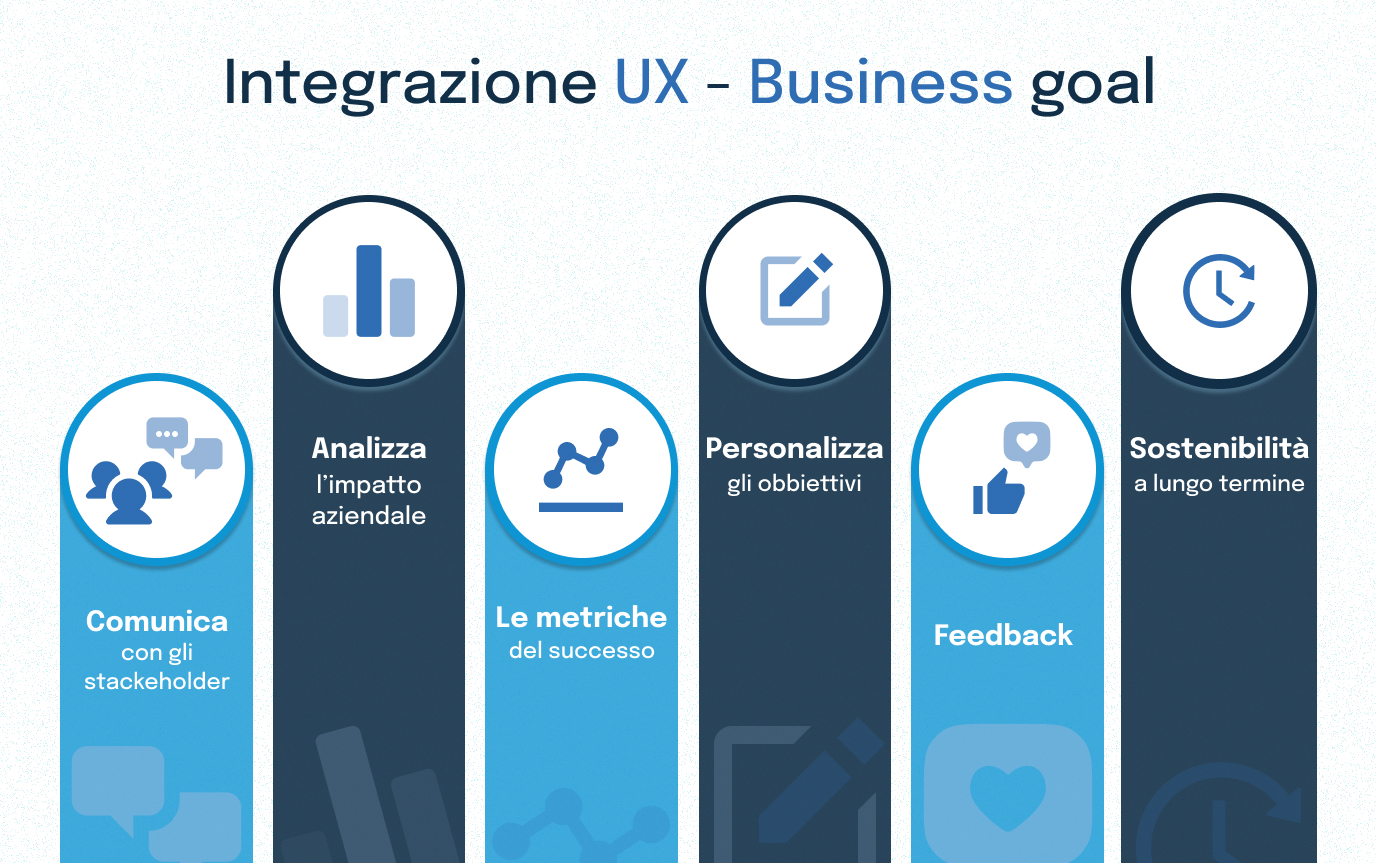
For a winning strategy it is essential to follow a flow of actions such as:
- Communication with business stakeholders
- Business impact analysis
- Using business success metrics in UX
- Personalisation based on business goals
- Continuous feedback and rapid training
- Long-term sustainability
At dotenv all these elements come together in projects built on an effective user experience that can support the company’s long-term growth. Discover the stages of our UX/UI process.
Communication with business stakeholders
The heart of BIUX Design is open, continuous communication with business stakeholders. UX teams have to work in close collaboration with key figures such as marketing managers, developers and company executives. This two-way collaboration ensures that every design decision is aligned with the company’s broader goals.
Example: Let’s imagine we are working with an e-commerce company that is launching a new product line. We would work actively with the marketing team to understand the sales goals, discussing how to adapt the interface of the site and the app to promote the new collection effectively. Together, we would create a user flow that guides visitors towards the flagship products, using targeted calls to action.
Business impact analysis
Before starting a design project, it is essential to carry out a business impact analysis. Which goals does the company intend to achieve? How can UX design contribute to those goals? These questions have to guide the decision-making process from the earliest stages of the project.
Example: Suppose the company’s goal is to increase the conversion of users into premium customers. We would carry out an in-depth analysis of the current user experience, identifying friction points and opportunities for improvement. We could then propose a design that simplifies the process of upgrading to the premium subscription, perhaps offering personalised incentives along the conversion path.
Using business success metrics in UX Design
The success of BIUX Design has to be measured not only against traditional parameters such as ease of use and user satisfaction, but also through tangible business metrics. These might include user engagement, conversion, retention and other business key performance indicators (KPIs).
Example: Let’s imagine we are working on a music streaming service app. We start by analysing the traditional metrics, such as average usage time and user satisfaction. However, to link UX design directly to business goals, we focus on more specific metrics, such as:
- User engagement: we introduce a new personalised recommendation system based on users’ musical tastes, increasing the time spent in the app as users discover and listen to more content.
- Conversion: we optimise the upgrade flow for premium subscriptions, increasing the conversion of free users into paying subscribers through personalised incentives.
- Retention: we implement interactive features and collaborative playlists that increase retention, encouraging users to stay active and share the experience with friends.
- New user acquisition: we introduce personalised promotions and special offers for new users, helping to acquire a wider user base.
- Monetisation: we analyse the correlation between the design of the track purchase screens and revenue growth, making sure the calls to action are optimised to maximise in-app purchases.
Personalisation based on business goals
BIUX Design involves personalising the user experience according to business goals. For example, if the company aims to promote a new product, the design should focus on targeted calls to action and user journeys that guide users towards the desired conversion.
Example: Working with an online clothing site, we would personalise product recommendations strategically. If the company wants to push overstocked items, the design could highlight these products in the most visible sections of the site and the app, encouraging users to explore and buy them.
Continuous feedback and rapid training
The dynamic nature of business calls for an equally flexible approach to design. Gathering continuous feedback, both from users and from business stakeholders, is crucial. Design has to be able to adapt quickly to the changing needs of the market and to new business opportunities.
Example: On receiving feedback from users of a social media app who complain about the complexity of the interface, we would take an iterative approach. We could introduce a new, simplified design based on user preferences, so ensuring a more intuitive and satisfying experience.
Long-term sustainability
BIUX Design is a long-term strategy. Design decisions should contribute to the sustainability and growth of the company over time. This implies constant reflection on how design can evolve to stay relevant in a market that keeps changing.
Example: Working with a food delivery app, we could design the BIUX taking into account new payment trends and the use of emerging technologies such as augmented reality. This would ensure the app stays at the cutting edge, ready to seize future opportunities and guarantee continued growth.
In a competitive digital landscape, Business-Integrated User Experience (BIUX) Design is the bridge between UX and business goals. Integrating these two aspects not only improves the user experience, but also helps to achieve long-term business goals. Investing in the connection between design and business strategy is the key to lasting success and to building a sustainable competitive advantage in the world of digital business.
Want to go deeper into UX Design? Listen to the latest episode of the Nessun Segnale podcast by dotenv, in which Fabian Niederkofler of Glueglue analyses how design has become a crucial element in the success of a business strategy.