In the constantly evolving economic context we live in, Italian SMEs are going through a crucial phase of digital transformation. The lessons learned from the recent pandemic and from current macroeconomic developments have made us even more aware that we are increasingly vulnerable to sudden changes that put companies’ long-term plans at risk.
New ways of working, such as smart working and hybrid workplaces, are redefining the professional landscape, while online communication platforms, such as Teams, are revolutionising the way meetings are run.
In this evolving context, there is a growing need to adopt advanced technological solutions as a strategic response to the challenges and opportunities of the modern market. Among the various technologies driving this transformation, Cloud Computing has become the beating heart of this digital revolution.
Dive into the article to find out more!
The many benefits of a Cloud platform
By allowing companies to access computing resources with a simple internet connection, the Cloud represents a turning point in the delivery of IT services. As well as replacing traditional on-premise infrastructure, it also offers a flexible service model. For example, the integration of artificial intelligence tools can implement specific solutions, such as management software and other services that support business operations.
So, with the Cloud, companies can implement new tools without buying and maintaining the hardware, significantly reducing maintenance costs.
Digital tools automate and integrate data, providing a solid basis for informed decision-making and better strategic direction. The computing power these applications require can easily be scaled according to need, allowing accurate cost control and efficient resource management.
This approach can not only significantly reduce IT costs for SMEs, but can also create a more sustainable business environment. Sharing resources on an optimised Cloud platform minimises the use of local resources, helping to reduce the environmental impact of running and cooling data centres. In addition, the scalability of the Cloud helps to use resources more efficiently, reduce waste and optimise energy consumption.
The Cloud Computing service models
The models for using cloud computing provide a flexible approach to managing a company’s IT resources. Let’s look at them through a symbolic metaphor: pizza.
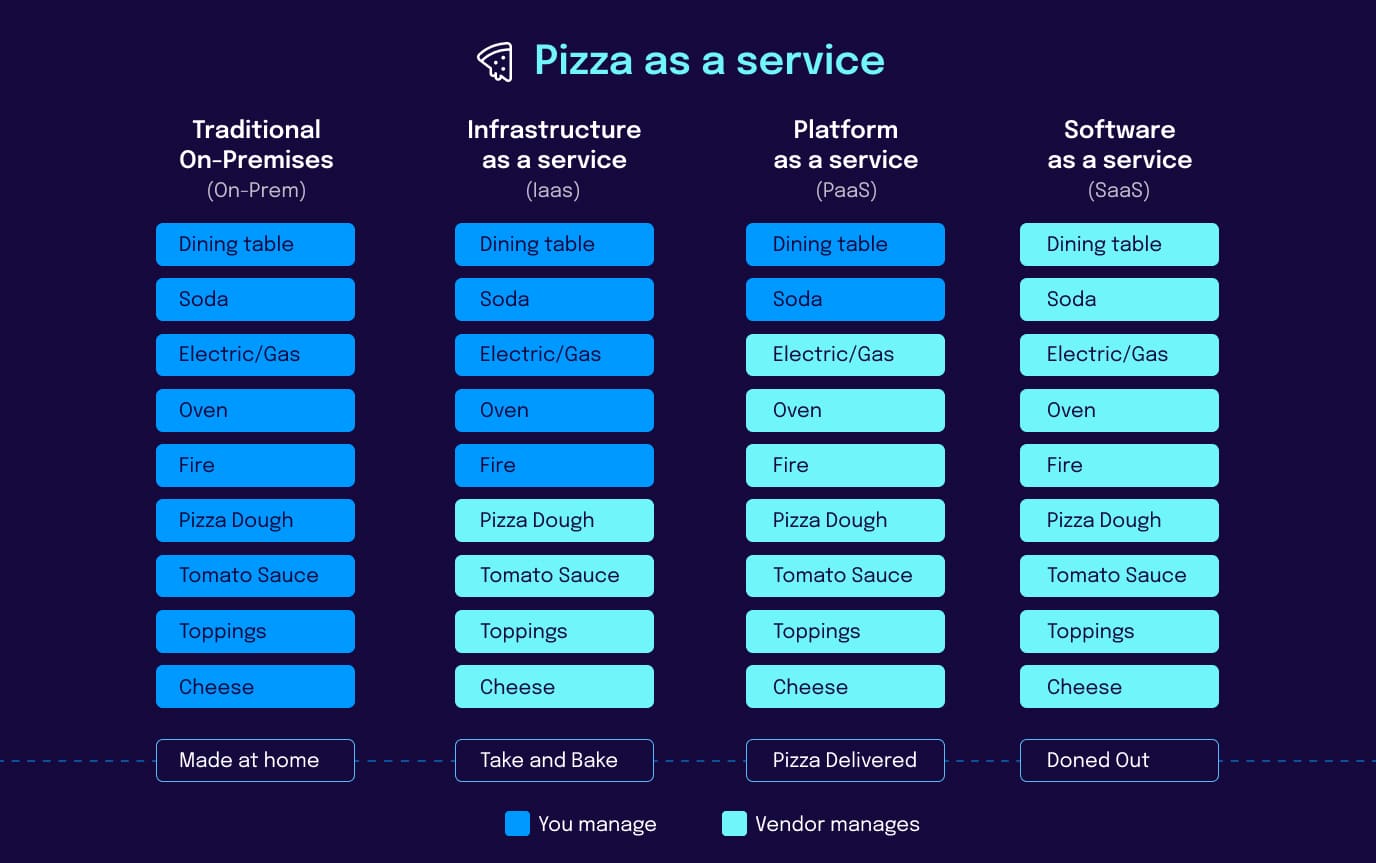
On-Premises (On-Prem)
The On-Premises model refers to IT infrastructure installed and managed directly inside the company. In this case, the company is responsible for everything, from hardware to software to maintenance. It is a traditional approach, the most widespread in the majority of companies, and the first one business owners generally think of.
Compared to making a pizza from scratch at home, it is like handling every aspect: from choosing the ingredients to baking it.
IaaS, Infrastructure as a Service
IaaS provides basic infrastructure such as virtual servers, storage and networking as a service. Users of the service control the environment and manage the operating system, the applications and the data.
In the pizza example, it is like receiving a frozen pizza (the basic infrastructure) and having control over how to bake it, which ingredients to add and how to serve it.
PaaS, Platform as a Service
The PaaS model, by making available a complete platform for development and management, allows developers to concentrate exclusively on building applications, without having to worry about the underlying infrastructure.
If we compared it to pizza, you would receive a ready-made base, to customise as you like by adding the ingredients you prefer.
SaaS, Software as a Service
SaaS provides complete applications as a service. Users typically access the applications through a browser without worrying about managing the application or the underlying infrastructure. Examples of SaaS services on the market are Microsoft 365 and Salesforce CRM, but they can also be software designed specifically for business services.
Going back to our pizza, this is like going to a restaurant and being served a ready-made pizza, exactly as we ordered it. In this case you do not have to worry about preparing the base or about baking it: you can simply enjoy your pizza!
Why Cloud Computing simplifies everyday life for SMEs
In the Cloud context, both software updates and infrastructure maintenance are handled directly by the service provider. This centralised management relieves SMEs of the burden of handling regular updates and solving routine problems.

In traditional on-premise models, business continuity is often affected by a series of external factors, such as simple power cuts. To allow access to and use of local company resources, many companies use VPNs, which make remote working easier by creating a virtual tunnel to the office. As a result, even the lack of internet connectivity can become a significant risk.
In addition, recent weather events, such as the floods, earthquakes and storm surges that have occurred in our country, have made us reflect on how keeping data on site at companies can jeopardise both the security and the continuity of work.
Managing backup and recovery in the “traditional” way has become increasingly complex because of the evolution of operating systems and the growth in the amount of data and in the size of the files generated and used every day.
Digital transformation through Cloud Computing is much more than a response to current challenges: it is also a strategic investment for the future.
In a context in which technology continues to be an important engine of change, the Cloud represents the first step that Italian SMEs can take to chart a path towards a sustainable digital future, successfully reinventing themselves.
Would you like to explore the subject of the digitalisation of Italian SMEs today? You can do so by following the latest episode of the podcast Nessun Segnale by dotenv with guest Federico Bocchini, Head of Information Technology in the Banking & Financial Services sector and author of the article you have just read.
And what if we told you that we can support your company in developing a personalised platform based on Cloud Computing? All that remains is to explore dotenv’s innovative software solutions and contact us for a dedicated consultation.