
The evolution of digital learning is bringing new possibilities and new challenges with it. The education sector, with the arrival of increasingly sophisticated technologies such as the new artificial intelligence tools, is changing radically. But which are the most useful AI tools of 2024 in the digital learning sector? In this article we will look at 6 of them, chosen by us on the basis of trends and features. Enjoy the read!
How AI tools are transforming digital learning
Artificial intelligence tools are transforming the education sector in innovative and promising ways. Thanks to their ability to analyse large amounts of data and to learn from them, these tools make it possible to achieve personalised learning, adapted to the individual needs of students.
Artificial intelligence algorithms can monitor students’ performance, identify areas of strength and weakness and provide immediate feedback to improve the learning process. Thanks to AI tools, it is possible to create personalised learning paths that adapt to the pace and learning style of each student. This evolution of digital learning offers new opportunities to sit alongside the classic ways of learning.
Language learning: Duolingo and ELSA Speak
Duolingo is a free app for learning languages, with more than 40 available. With over 500 million users worldwide, it is one of the most popular language learning apps.
Duolingo offers short, interactive lessons that cover different aspects of a language, such as vocabulary, grammar, pronunciation and conversation. The lessons are gamified, with points, levels and rewards that motivate the user to keep learning.
As well as being a free, engaging and fun application, Duolingo is also effective, flexible and encourages healthy competition between users. However, it also has some limits, since it does not present itself as a complete substitute for a traditional language course and may prove unsuitable for some levels of preparation. It remains, in any case, a faithful ally for learning and strengthening foreign languages.
 ELSA Speak is a free mobile application, which also has paid plans, that uses artificial intelligence to help users improve their English pronunciation. It is designed specifically for people who are not native English speakers and want to improve their fluency and command of the language.
Using cutting-edge speech recognition technology, this app analyses the pronunciation it detects and identifies the areas for improvement. It then provides real-time feedback on aspects such as phonetics, intonation and rhythm.
ELSA Speak offers a personalised curriculum with interactive lessons, making use of gamification mechanisms, which cover a wide range of everyday conversation topics. Each lesson includes listening, repetition and voice recording exercises.
Like Duolingo, ELSA Speak does not replace formal teaching by a native-speaker teacher either. The two apps differ in one fundamental respect: the first also includes vocabulary and grammar lessons, while the second focuses mainly on pronunciation and is not designed to teach other aspects of the language in depth.
Text transcription: Transcribe
Transcribe is a speech-to-text transcription app that uses AI to generate notes automatically from audio, meetings, interviews, videos etc. in more than 120 different languages. The app supports various audio and video formats and allows the generated documents to be exported, here too in several accepted formats, with timestamps for any later refinement.
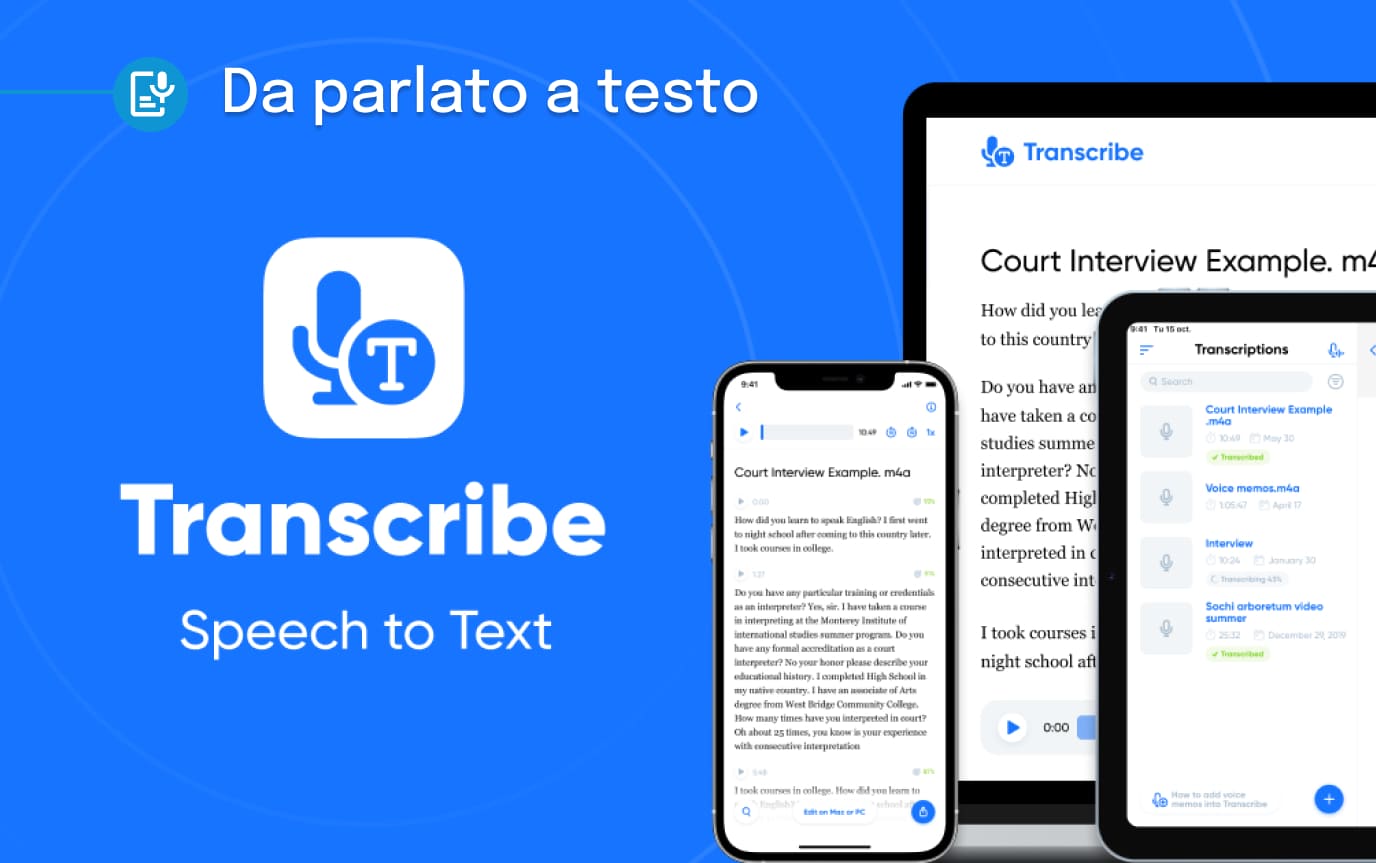 Transcribe offers 3 plans: Free, Pro and Business, with the option of buying extra credits for long transcriptions, and it is an official partner of Zoom, to which it can be added in order to get transcriptions almost instantly. This is why the app lends itself very well not only to student use but also to business use.
Learning mathematics: MathGPTPro
MathGPTPro is a powerful artificial intelligence tool developed by OpenAI that helps to solve complex maths problems, including equations, calculus, geometry, trigonometry and statistics. Launched in 2023, it has spread to more than 100 countries, standing out for an accuracy rate of 90% on maths problems, ahead of ChatGPT, which stands at 60%.
The app provides step-by-step explanations of the problem-solving process, can generate graphs and diagrams to illustrate mathematical concepts and make them easier to understand and, through an interactive tutoring system, lets users interact with a virtual teacher and receive personalised help.
 As noted for the other tools mentioned, MathGPTPro does not completely replace each user’s independent learning and practice either: users will have to keep studying and practising to strengthen their skills.
PDF processing: EduEase
PDF processing is one of the areas with the most tools of all, along with content creation. We have chosen to share the free tool EduEase, which makes it possible to generate multiple-choice quizzes, in a few minutes, from a PDF file, giving students a dynamic and engaging learning path. Once the file has been uploaded, the artificial intelligence technology produces quizzes that can then be reviewed manually, also as a safety check, and shared.
 This tool guarantees a considerable saving of time in preparing short tests to check how well a given topic has been learned. However, it is a good idea to reread the generated content since, as with all AI, a so-called hallucination may occur, leading to inaccurate information.
Assessment: Gradescope
Gradescope is a web and mobile app that helps teachers to speed up and optimise the process of marking and grading assignments, using artificial intelligence to recognise text and graphs automatically. Once the files have been uploaded, Gradescope uses handwriting recognition to identify students’ names and answers, organising them for grading.
This app offers several features to make assessment more efficient and accurate, including:
- Scanning of paper assignments and their conversion into digital files.
- Digital annotation features, such as highlighting, underlining, adding text and shapes, together with personalised feedback for each student.
- Personalised grading rubrics with specific criteria for each assignment, and automatic allocation of scores based on the rubric criteria.
- Sharing of assignments with other teachers or with the students themselves, for reviews or collaboration.
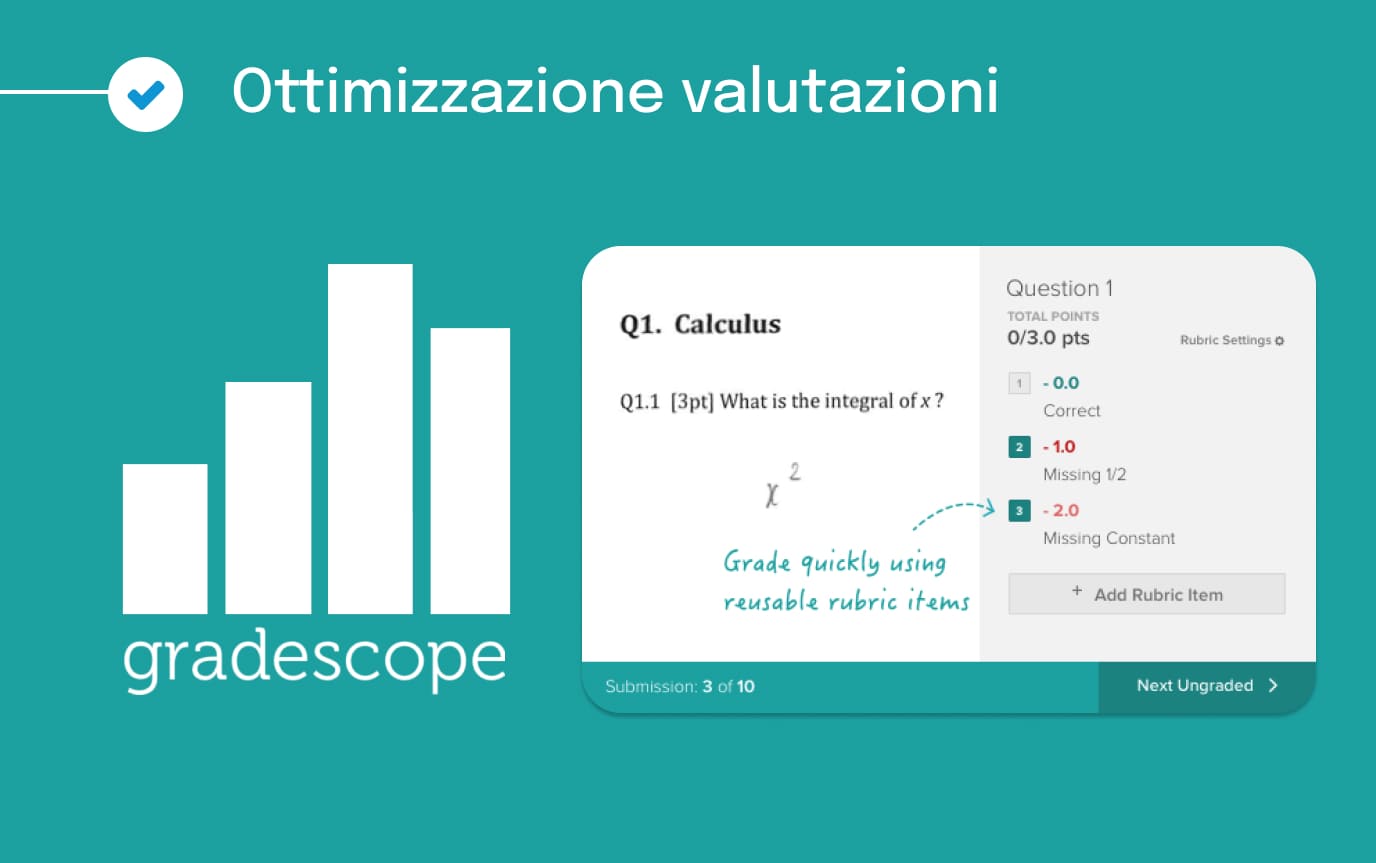 Gradescope gives students the chance to get automatic feedback, which is sent to them on the basis of their answers to help them understand their mistakes better and improve their future performance. The data collected at this stage can be used to monitor the progress of students and to identify potential areas for improvement.
The app is available in a free and a paid version. The free version offers basic features, while the paid version includes advanced features such as automatic scanning of assignments, the creation of personalised grading rubrics and the generation of detailed reports.
The future of digital learning: opportunities and challenges
Digital learning, with the support of artificial intelligence technologies, is an increasingly relevant approach to education. One opportunity that digital learning can offer is undoubtedly the valuable source of information on students’ progress, coming from the use of AI tools, which teachers can draw on to adapt lessons to individual needs. In addition, the informed use of these technologies could widen the possibilities for learning beyond the traditional boundaries of the classroom, allowing students to access global educational resources and to collaborate with other students all over the world.
The future of digital learning does, however, present some challenges to be tackled, such as guaranteeing fair access to AI tools for all students, regardless of their economic or geographical situation, and maintaining a balance between the use of technology and human interaction, so that students do not feel isolated or deprived of the important social interaction that classroom learning can offer.
One reflection remains, and it concerns balancing the use of technology with the need to keep a human approach in learning: how can we make sure that artificial intelligence stays at the service of students and not the other way round? One point of view came from Massimo Bertasi of Istituto Cappellari in the 15th episode of the podcast Nessun Segnale by dotenv. Don’t miss it! Choose the platform you prefer among YouTube, Spotify, Apple Podcasts, Google Podcasts and Amazon Music.