How does artificial intelligence work?
Artificial intelligence simulates abilities and behavioural processes observed in human beings, and the premise is getting a machine to solve a task without being told explicitly how to carry it out. The engineer Marco Somalvico defined it as the discipline that studies how to give a computer performances that a common observer would think exclusive to the human intellect.
Artificial Intelligence is a flourishing, interdisciplinary field of computer science that aims to create machines with cognitive abilities and functions similar to human intelligence, covering complex areas such as visual perception, speech recognition, decision-making and language translation. With its constant growth and evolution, in recent years AI has reached the potential to transform and revolutionise several sectors, including healthcare, finance and transport.
All the wonders that come from the development of artificial intelligence are the outcome of the collective efforts of researchers, scientists, engineers and developers who have worked tirelessly over the years to map together different fields of knowledge, such as Mathematics, Computer Science, Neuroscience, Psychology, Philosophy and Linguistic Studies. But what exactly is AI, and how do these disciplines intertwine to form the technology we have come to know?
Let’s find out together!
What Artificial Intelligence is
Let’s start from the basics: how does artificial intelligence work? What exactly is it? Marco Somalvico, an Italian engineer and AI specialist, defined it like this:
“It is a discipline of Computer Science that studies the theoretical foundations, the methods and the techniques that make it possible to design hardware and software systems capable of giving an electronic computer levels of performance that, to the ordinary observer, would seem to belong exclusively to the human intellect.” (Source: https://bit.ly/Treccani-Intelligenza-Artificiale)
In short, artificial intelligence is the simulation of the abilities and behavioural processes observed in human beings.
The premise for the development of Artificial Intelligence is simple: get a machine to solve a task without explicitly telling it how to carry it out. At first this may seem impossible, but it is nothing more than a mathematical problem. When the problem is too complex to be solved algorithmically, we turn to a machine so that it finds a “probable” solution in our place. But how does this process happen? Through the acquisition of a large amount of data: the more representative of the problem the data is, the better the results obtained will be (it is the typical concept of Garbage in Garbage out).
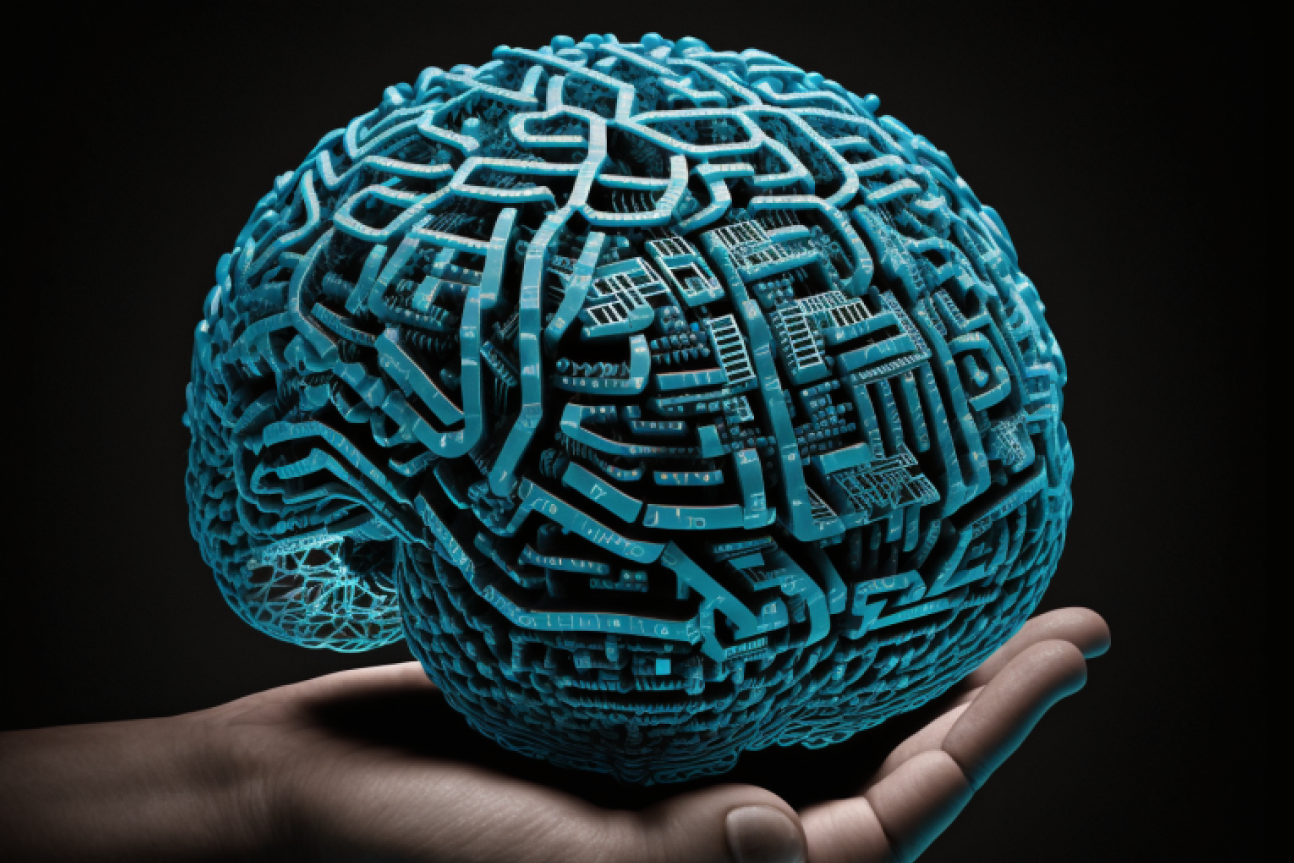
The fundamental process of Artificial Intelligences
When we have a set of input data and a corresponding set of output data which, taken together, form the “dataset”, we have to find a mathematical function able to connect the two sets of data in a predictable and statistically accurate way (a bit like when we try to derive a function from a series of points on a plane). The dataset is split into a “training” set and a “validation” set, which will be used respectively to train and to validate the ability of the function generated by the artificial intelligence to solve the problem. This method is applied iteratively through several “generations” in which the AI tries, at first, to guess a function that somehow performs better than all the previous generations of functions. Once training is over, the AI will become a “model”, a sort of mould made up of a set of numbers and functions able to transform a given input into the corresponding output with a high degree of certainty on the basis of the dataset provided.
There are many types of models and architectures that have been studied and refined in recent years. The most important are in the field of Machine Learning (ML), where we find them used to build architectures such as Deep Learning systems for deep neural networks, convolutional neural networks, natural language processing and much more.
Machine Learning and GPT: benefits and critical issues
Within artificial intelligence, one of the most important and noteworthy developments has been the Generative Pre-trained Transformer (GPT), an innovative and advanced machine learning model that uses neural networks to generate text in natural language. It was developed by OpenAI, an important non-profit research entity dedicated to advancing AI in a safe, ethical and beneficial way.
In 2019 OpenAI published the revolutionary paper Language Models are Unsupervised Multitask Learners, together with the associated code and models, allowing anyone in the world to experiment with and develop their own GPT-based AI. GPTs belong to the same field of study as Large Language Models (LLMs), which were brought into wide circulation in 2018 by OpenAI itself.
Characteristics and advantages of GPTs
Thanks to its broad scope and versatility, the GPT model can be trained on a vast body of text, including books, articles and websites, using an unsupervised learning approach in which the system predicts the next word in a sequence of text, allowing the model to recognise certain patterns and establish relationships between the data.
The result of this training process is a model with a high degree of fluency and coherence, able to generate text in natural language comparable to human writing. GPTs have a wide range of applications, including automatic content creation, chatbots and language translation. For this reason the model has gained popularity among developers, researchers and companies, presenting itself as a powerful and flexible tool for improving productivity and innovation.
Between 2018 and 2023, OpenAI released four main versions of the GPT series, the latest of which is GPT-4, by far the most capable. No longer tied to text-based interactions, the model is a multimodal LLM trained on enormous amounts of data from the Internet, books, articles and research papers, with a higher number of parameters than its predecessor GPT-3, which had been trained on 175 billion parameters.
Critical issues and potential risks connected to GPTs
Despite their many benefits, GPTs have been the subject of some criticism and limitations, in particular as regards the potential for bias and the ethical problems in artificial intelligence systems, above all in the translation sector, where cultural sensitivity and nuances can easily be overlooked. In addition, the size and complexity of models such as GPT have raised questions of transparency, accountability and the difficulty of understanding and interpreting the underlying processes.
As for the safety of artificial intelligence development, in April 2021 the European Commission proposed a policy for a regulatory framework on AI that sets out the risks AI entails and the rules it would need in a growing technological world.
In March 2023, an open letter from the Future of Life Institute, signed by several AI researchers and technology executives, asked to pause for 6 months the training of Artificial Intelligences more powerful than GPT-4. The reason? Concern about the possible existential risks connected to their development. One example is the so-called “technological singularity” (AI Singularity), a concept that refers to a hypothetical future moment in which technology will grow in an uncontrollable and irreversible way, causing unpredictable changes to human civilisation.
In Italy, with the arrival of such powerful systems, the Garante per la protezione dei dati personali ordered, with immediate effect, the temporary limitation of the processing of Italian users’ data by OpenAI. In its order, the Garante points to the lack of information provided to users and to all the data subjects whose data is collected by OpenAI and, above all, the absence of a legal basis justifying the mass collection and storage of personal data. While waiting for OpenAI to resolve the matter, it has limited the use of its services in Italy.
Now that we have answered the question “how does artificial intelligence work?”, another question arises naturally: what should we expect in the future? For now the question remains open.
Technology and digital innovation are the daily bread of the dotenv team: with our support you can automate some business processes or give your business software solutions able to simplify certain internal procedures. Tell us about your project and we will tailor the best strategy to reach your goals!