
Many innovations make no noise when they arrive. The web, in the mid-’90s, seemed little more than a fad. Social media? Stuff for teenagers. Artificial intelligence? Too academic, until it made its way into our CRMs, search engines and chatbots. Today there is a new term starting to circulate in the boardrooms of the most forward-looking companies: quantum computing. But is it really relevant to the business world? Let’s find out together.
Quantum computing explained without formulas
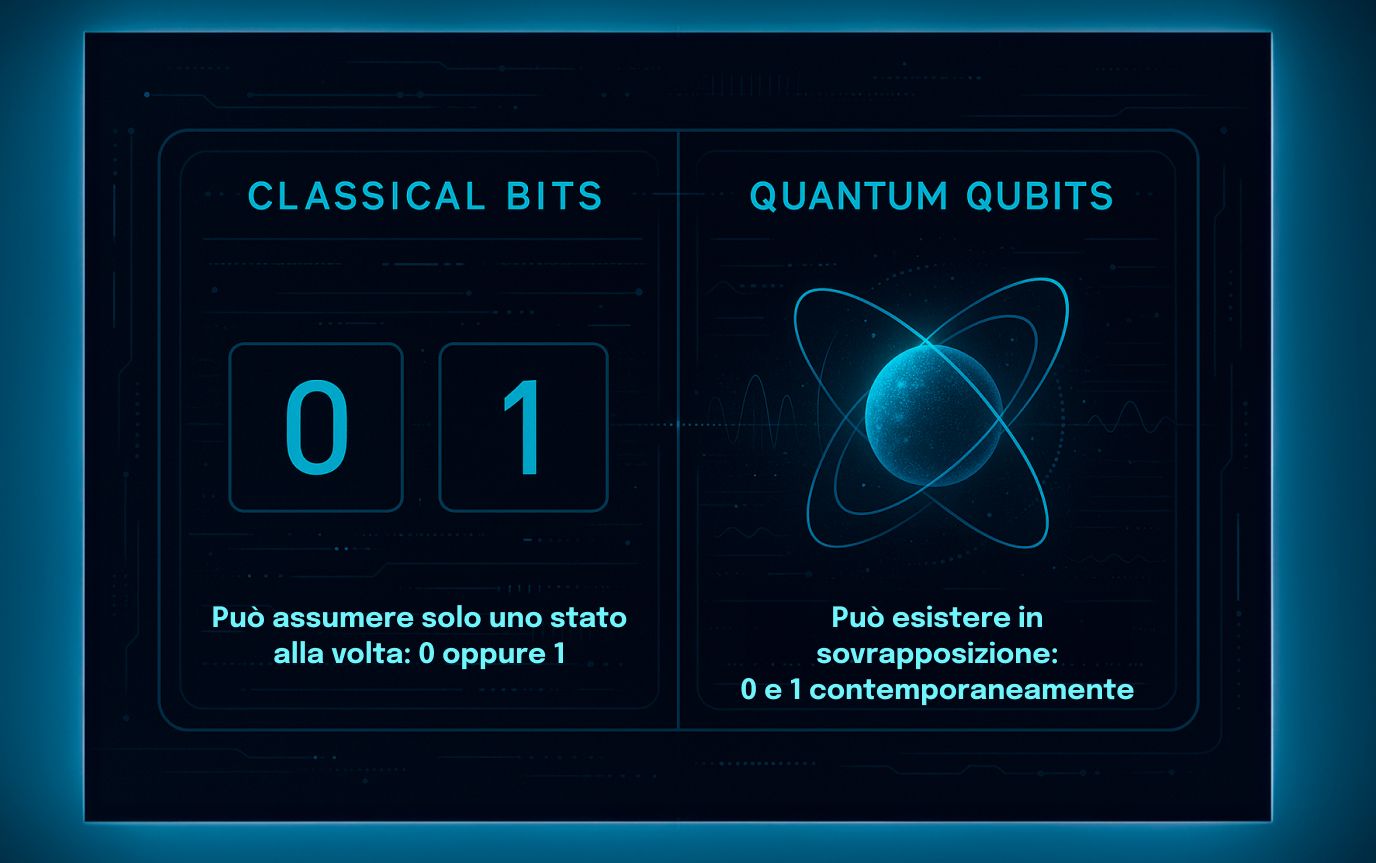
Quantum computing is a technology that uses the principles of quantum physics to perform calculations in a radically different way from classical computers. No longer bits that are worth 0 or 1, but qubits that can represent several states at the same time, leading to exponentially greater computing power.
But be careful: it is not a more powerful version of today’s computers. It is a completely new way of tackling certain types of problems, such as:
- Complex molecular simulations (pharmaceuticals, chemistry, materials)
- Optimisation of complex systems (logistics, production, supply chain)
- New cryptography for the post-quantum era
- Acceleration of some machine learning algorithms
In short: it is relevant for anyone who works with complexity. And who, today, does not?
Why a company should adopt quantum computing today
Those who take strategic decisions should not be asking whether today is already the time to invest millions in quantum technologies. They should instead be asking: how much is it worth to me to be ready when adoption really begins?
There are moments when “getting there first” simply means starting to understand earlier. And this is one of those moments.
Approaching quantum computing now means:
- Building internal awareness, so as not to be caught unprepared
- Assessing in advance the competitive implications in sectors where simulation and optimisation are crucial
- Attracting high-profile tech talent, people who want to work on frontier challenges
- Repositioning yourselves as innovators, even just by exploring pilot projects.
Let’s remember that the companies that in 2010 had set up small internal labs on AI are today leaders in the sector. Those that ignore quantum now could find themselves playing catch-up in a few years.

What can already be done today, in practice
Even without investing in hardware or dedicated teams, there are smart actions with low impact but high strategic return:
- Starting exploratory projects with tech partners or universities
- Offering selective training to innovation or R&D teams
- Subscribing to quantum cloud platforms for testing (Azure, IBM, AWS)
- Supporting your team of data scientists with people who have hybrid skills (quantum-AI)
- Beginning a constant monitoring of regulatory developments, in particular on cryptography and compliance
In other words: starting to build a cushion of technological awareness, which can be activated when the time is ripe.
Hype? Yes, but like every great change!
Quantum computing today is, without doubt, surrounded by hype. But so was AI in 2015. The cloud in 2010. E-commerce in 2000. All technologies that seemed “too premature”, and that then revolutionised business models drastically. Quantum will be no different. The question is: when will it start to do so in your sector?
The strategic vision companies must have today
A forward-looking leadership does not wait for the technology to be mainstream; it informs itself, experiments, observes. Without being dazzled, but without being paralysed by doubt either.
Right now, quantum computing represents a lens through which to rethink complexity. Anyone who today deals with problems of optimisation, simulation, cybersecurity or artificial intelligence should at least understand its potential.
There is no need to predict the future. It is enough to prepare to recognise it when it arrives!
As a software house, we are always curious explorers in the field of new technologies: scenario analysis, prototyping and training are fundamental to evolving as a company and enriching our background.