
News from the world of cross-platform application development: ByteDance, the company behind TikTok, has introduced Lynx, a brand-new framework based on Rust, designed to maximise performance in mobile development. Inspired by the feline it takes its name from, Lynx aims to offer lightning speed, precise execution and exceptional adaptability across multiple platforms. But let’s find out more!
Some examples of Lynx already in use in TikTok’s products
Examples of development in Lynx can already be found in high-traffic applications within the TikTok ecosystem, including the search panel, TikTok Studio and also complex experiences such as TikTok Shop and LIVE. Its ability to support high-profile events such as Disney100 and the Met Gala on TikTok shows its value in delivering engaging and reliable experiences.
Unlike established frameworks such as React Native or Flutter, Lynx introduces a multi-threaded UI rendering engine, designed for high-performance applications.
A web-native architecture for a modernised development experience
Lynx takes an innovative approach to component design, coming much closer to web development than traditional mobile frameworks do. Compared with React Native, which requires the use of JSX and of its own styling system, Lynx offers:
- Native support for CSS, including variables, animations and transitions
- HTML-like markup for building UIs, easing the transition of web developers towards mobile
- Familiar componentisation, with a development model based on ReactLynx.
Optimised performance thanks to a multi-threaded architecture
One of Lynx’s strengths, as we said at the start, is its multi-threaded UI engine, which separates rendering and application logic:
- The UI thread (PrimJS Engine) handles the rendering of events and the animations
- The logic thread runs the application logic separately, avoiding slowdowns
This architecture eliminates the bottleneck of React Native’s JavaScript bridge, allowing:
- Faster UI updates
- Animations with no dropped frames
- Almost instant loading times
Component Architecture: declarative and high-performing
Lynx follows a component-based UI model, similar to React but with key optimisations:
- Declarative, native components, with tags such as
, , and , mapped directly onto native elements of the platform - Styling based entirely on CSS, removing the need for JavaScript-based systems such as Styled Components or Tailwind
Thanks to its full support for CSS, Lynx offers:
- Native animations and transitions
- Advanced handling of gradients, shadows and variables
- Use of CSS modules, global styles and inline styles.
Versatility and adaptability to different JavaScript frameworks
The developers of Lynx chose React as the initial frontend framework, but they are keen to stress that Lynx is not tied exclusively to React.
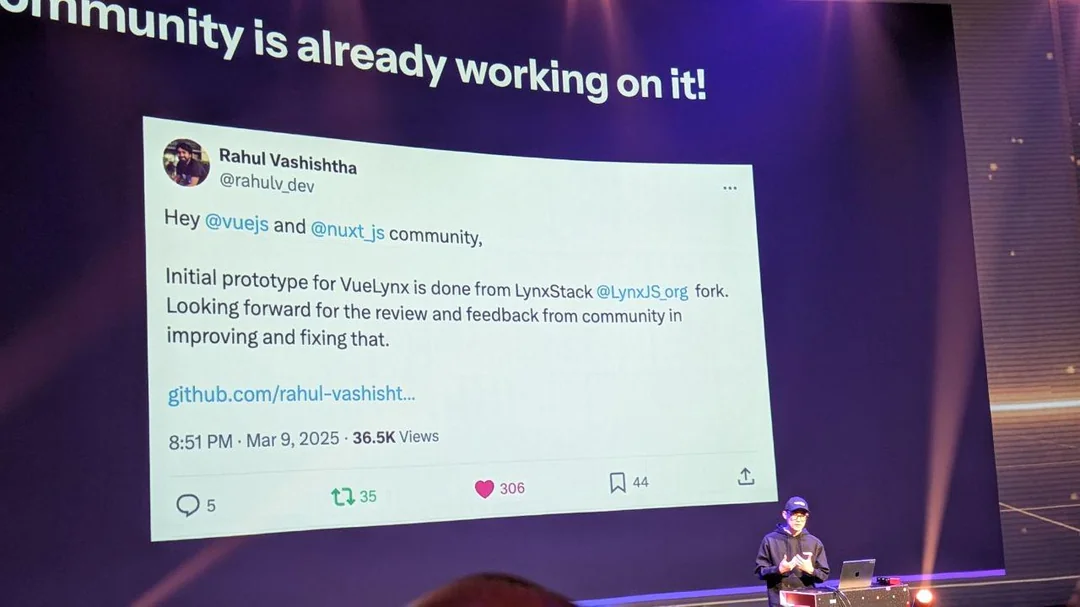
Thanks to its framework-agnostic approach, the community has shown strong interest in integrating other frameworks as well, such as Vue, Svelte and Angular. Confirming this openness, during the VueJs Amsterdam conference, Evan You (the creator of Vue) talked about VueLynx, an integration currently at the prototype stage.
As well as supporting different frameworks, Lynx takes inspiration from projects such as Chromium, Flutter and React Native in order to be independent of the host platform too. This means that it can adapt to new platform primitives and integrate custom renderers, guaranteeing an optimal experience on any device, from the web through to IoT.
At dotenv we have tested Lynx’s development performance and we are very confident about its future potential.
Its global adoption will depend on the growth of the ecosystem, on the development tools and on the industry’s interest. However, its architectural advantages are clear: those who adopt it first could be among the pioneers of the new generation of high-performing, interactive mobile applications.
Thanks to its openness to the open-source community, Lynx has the potential to become a new standard in cross-platform development, offering a unified, fast and scalable solution for the future of digital applications.