
In today’s digital landscape, multicloud is establishing itself as one of the cloud computing strategies most widely adopted by companies looking for flexibility, scalability and control. But what does multicloud really mean, what are its advantages and how can companies get the most out of it? Let’s find out together in our blog article.
What is multicloud?
Multicloud is an approach that consists of using cloud services delivered by several vendors, and that makes it possible to combine the best services offered by providers such as AWS, Google Cloud, Microsoft Azure and others. It is not just a matter of choosing different vendors for SaaS, but often of using PaaS (platform-as-a-service) or IaaS (infrastructure-as-a-service) solutions tailored to the company’s needs.
A multicloud solution stands out for:
- Portability: thanks to open-source technologies such as Kubernetes, applications can run on the infrastructure of different providers.
- Centralised management: unified consoles make it possible to administer workloads across several clouds efficiently.
- Advanced support: built-in features for AI, machine learning, disaster recovery and more.

Why choose multicloud?
Companies that adopt multicloud can benefit from a series of key advantages, such as:
-
Flexibility and adaptability: thanks to multicloud, organisations can choose the best services for specific requirements, such as pricing, performance, compliance and geographical location, avoiding “vendor lock-in”, that is dependence on a single vendor.
-
Better resilience: a service outage on one cloud does not compromise the company’s entire infrastructure. Multicloud therefore reduces the risks linked to downtime and technical problems.
-
Access to the best technologies: multicloud makes it possible to adopt quickly the new technologies offered by the different vendors, keeping the company at the cutting edge.
-
Cost optimisation: thanks to the freedom to choose between providers, it is possible to select the most cost-effective options for each workload, maximising economic efficiency.
Multicloud vs Hybrid Cloud
Often confused with Hybrid Cloud, multicloud differs in type of vendors, integration, objective and focus:
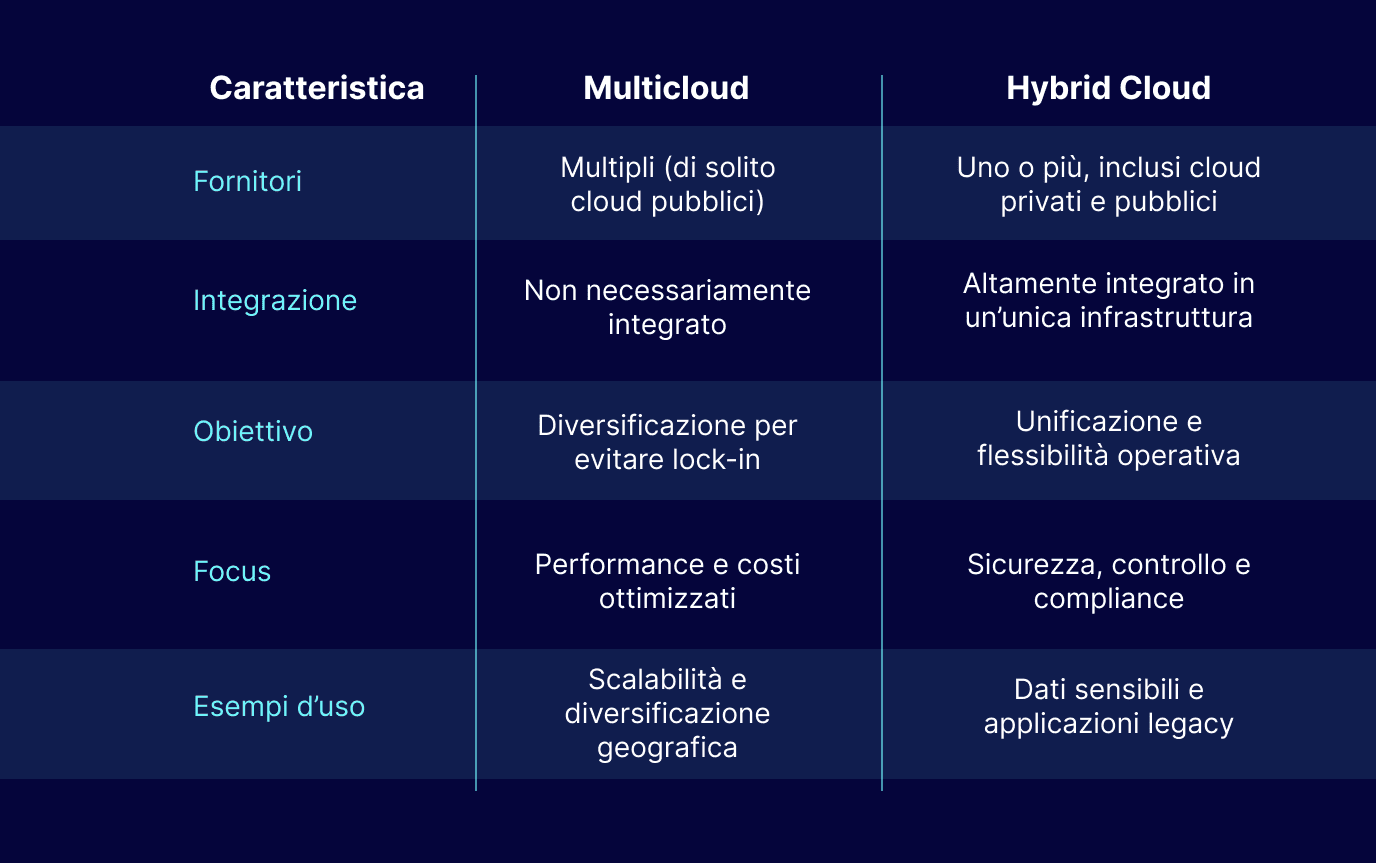
Multicloud is ideal for those who want to exploit the advantages of several public vendors without tying themselves to just one, while Hybrid Cloud is perfect for those who want integration between public clouds, private clouds and on-premises resources to maximise flexibility and security.
Companies often combine the two approaches in a Hybrid Multicloud, taking the best of both worlds.
The challenges of multicloud management
Despite its many advantages, multicloud presents some significant challenges:
- Security and compliance, that is guaranteeing consistent policies across the various providers
- Interoperability: integrating applications and services between different environments
- Cost optimisation by monitoring and controlling spending, to avoid waste.
How do you tackle them? With orchestration
It is essential to adopt orchestration tools, which make it possible to manage centrally:
-
Simplified, automated processes
-
Seamless connection between different environments
-
Constant monitoring and protection
-
Control and optimisation of performance and costs.

How to start the multicloud journey
For Italian companies, multicloud is an opportunity for growth and innovation. According to the Osservatorio Cloud Transformation del Politecnico di Milano, in 2025 62% of Italian businesses use multicloud strategies, a steady increase on the 51% recorded in 2023. This shows an increasingly mature and strategic adoption.
The transition requires a well-defined plan:
-
Needs assessment: identify the workloads and applications best suited to multicloud.
-
Choice of providers: select vendors that meet specific performance, security and cost requirements.
-
Gradual implementation: gradually integrate the cloud services with the existing infrastructure.
-
Use of advanced tools: adopt multicloud management platforms to centralise control.
Multicloud is a tailored solution that lets companies get the best out of every cloud provider. Thanks to a strategic approach and the use of advanced technologies, organisations can successfully face the challenges of digital transformation, improving resilience and keeping a competitive advantage in the market.
Adopting multicloud management tools, combined with a DevOps approach, makes it possible to build custom software solutions that not only respond to current needs, but adapt quickly to future changes in the market.
Want to know more?