If we wanted to explain an image that exists only inside our head, so that others understand what we mean, we would need to choose our words carefully and give the most detailed description possible. But how can we know whether the image that has formed in the other person’s mind matches the one we had in ours? We can’t, unless we set about representing it visually.
There is, however, a piece of software called Midjourney with which you can put yourself to the test by making use of Artificial Intelligence. Today we will explain why we chose to use this software to build dotenv’s new corporate image.
What Midjourney is and how it works
As stated on the platform’s website, Midjourney is “an independent research lab exploring new mediums of thought and expanding the imaginative powers of the human species”, but it is also the name of the lab’s AI program that creates images from text descriptions. The platform was launched by David Holz, co-founder of the virtual and augmented reality startup Leap Motion, later acquired by the company UltraHaptics.
Building on the creativity that sets our team apart, we chose to use Midjourney to create unique graphics found on our website, in particular in our Blog, and on our social media.
When we decide to cover a particular topic in our communications, we then think about how to describe it to Midjourney. Thanks to a series of keywords entered in a prompt, the software returns personal, unique high-definition images.
Here is an example:
frozen glass tree with frozen glass flowers, ray of light, detailed and intricate environment, materiality, unreal engine, octane render, hyper detailed, hyper quality, hyper realistic, insanely detailed, 8k, global illumination, volumetric light, soft studio light, high contrast, creative, post production –ar 8:6 –no leaves –upbeta –testp –creative –upbeta
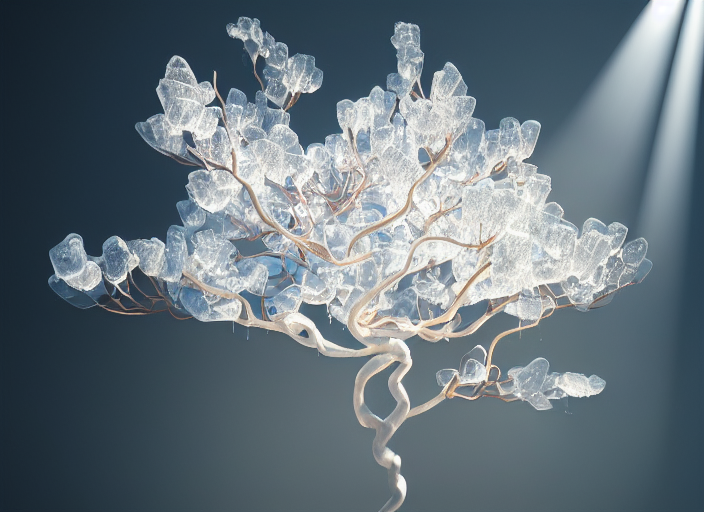
Simple as it may seem, generating images with AI is a very complex operation: it is essential to describe in as much detail as possible the image you have in mind or the concept you want to render visually. Are we able to describe exactly what we are thinking of? Can we translate our emotions into letters?
dotenv’s challenge with Midjourney
So we tried our hand at this new tool. It was quite a challenge, because generating images with Midjourney takes concentration, introspection and self-criticism. In fact, it is not at all easy to get the render of the image you want at the first attempt.
To access Midjourney you need an account on the messaging app Discord. At this point, you have to buy a plan to use the software. It is very important to read the instructions carefully before going on to fill in the Midjourney prompt, since there are numerous codes that can return a completely different final result. These codes are used, for example, to decide how abstract you want the image to be, its level of detail, the format and even the artistic style to give our “creations”, such as impressionism or pointillism. If you are not satisfied with the result, you can change the description or make it more precise, so that the software returns the image as close as possible to the idea you had.
Midjourney is a clear example of how AI can be at the service of human abilities. One question arises naturally: is the world of graphic and artistic creation as we have known it until now at risk of being threatened by Midjourney’s potential? It will certainly be influenced and will need particular attention, above all to defend itself against so-called deep fakes.
Would you like to take a look at some of the images we have generated so far with Midjourney? Take a look at the graphics of our experiences!