
What does it cost to build an app?
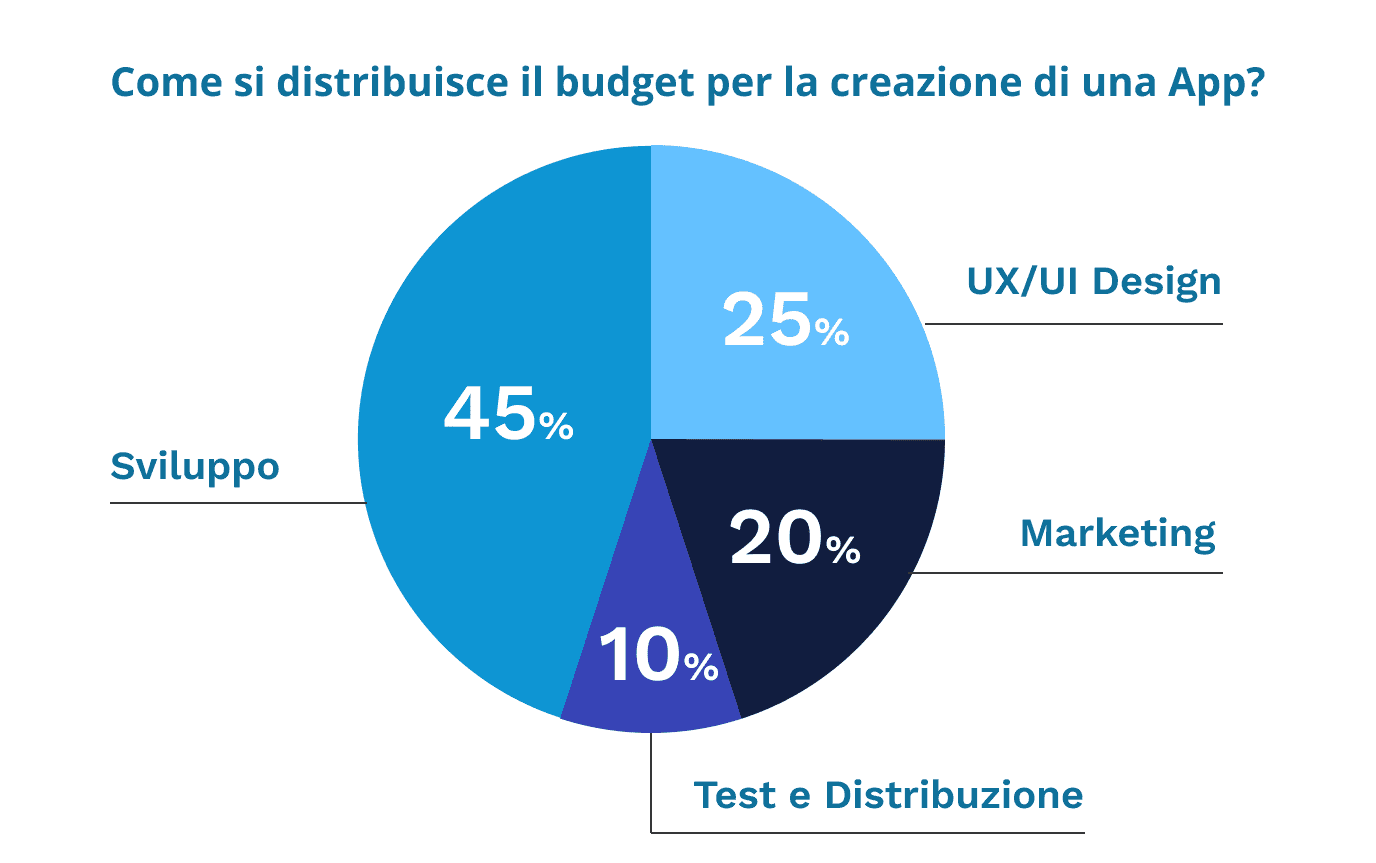
There is no price list: published research runs from a few thousand euros to close to €300,000 for complex projects. What moves the number is the scope, not the technology. On the same sources design takes 20 to 25% of the budget and development 40 to 55%.
There is no price list, and anybody who gives you one over the phone is guessing. But the items that make up the price are always the same, and knowing what each one weighs lets you read a quote instead of accepting it.
The percentages below come from research on development costs and are orders of magnitude, not a tariff.
What actually moves the number
Not the technology. The scope.
An app with twelve screens and no integrations costs a fraction of the same app that has to read from and write to the ERP, handle permissions for three departments and work with no network. The cost is in the connections, not the screens — which is why two quotes for the same specification can differ by a factor of three: they are imagining two different scopes.
The second thing that moves the number is how well defined the scope is when you start. A vague specification does not save money: it moves the cost later, where changing things costs more.
Analysis, which looks like a cost and is not
This is where somebody goes and watches the process where it happens. It looks like the thing to cut, and cutting it is what blows up quotes: the surprises do not disappear, they arrive later.
Design: 20 to 25% of the budget
This is where you decide how the app is used. On a business app it is not about looks: it is about how many times a day a warehouse operator touches the screen, and whether they can do it with gloves on.

Cutting it is paid back later, in support and in features nobody opens.
Development: 40 to 55%
The biggest item, because it covers three things that often get counted as one: the part you see, the part you do not, and the integrations.
Integrations are almost always underestimated. A fifteen-year-old ERP has no interface designed to be queried, and making it talk without touching it is real work.
Testing and go-live: 15 to 20%
Between €5,000 and €50,000 on the same research, depending on complexity. It includes migrating the data that was there before — usually the long part, not because moving it is hard, but because somebody has to decide what to do with the rows that do not add up.
And promotion?
On a consumer app it is a major cost, often as large as development. On a business app it does not exist: the users are yours, and what you need instead of promotion is training — short, on site, with the real system.
If somebody puts promotion in a quote for a shop-floor app, they have copied the wrong template.
Native or web: how the total changes
A native app costs more for the same features, for two reasons that often go unsaid: it has to be written and tested on two systems if you need both iPhone and Android, and every new operating system version demands maintenance even when you have changed nothing.
A web app costs less and updates in one place, but does not reach everywhere: rapid barcode scanning, hours offline, specific hardware.
An installable web app sits between the two: on the home screen, working without a network, updating without going through a store. On many business projects it is the choice that saves the most, and it is rarely offered because it is less sellable.

The costs that turn up later
- Routine maintenance. Not faults: new versions of operating systems, browsers and libraries. It exists even if you touch no feature.
- Infrastructure. Servers, database, backups, certificates. A small monthly figure, but for years.
- Store accounts, if the app is published. Annual, and yours: have the account registered to you, not to the supplier.
- Training and support when it reaches the shop floor.
- Further development, which always comes, because software that gets used generates requests. That is a good sign.
A quote that does not mention these is not cheaper: it is incomplete.
What a quote needs to be comparable
If you are looking at three and they are very different, they are usually not quoting the same thing. Five lines make them comparable:
- The list of screens, not features: features get counted in different ways, screens do not.
- The integrations, one by one, saying which system and which direction the data flows.
- What happens when the source system is down.
- Who owns source, documentation and accounts.
- What is included after go-live, and for how long.
Why the range is so wide
Published figures run from a few thousand euros to close to €300,000, and both are true: they describe projects with nothing in common. A serious quote is not a number, it is a number tied to a written scope.
How to avoid finding out halfway through
By defining the scope first and renegotiating it at fixed intervals instead of by surprise.
If you have to budget an app for the business, the defence against a surprise cost is the custom method: half a day on the process where it happens, a written perimeter, and every few weeks something working to try on real data. Architecture decisions and responsibility for the release stay with a named person. Work like this runs for months, and the figure stays the one you budgeted.
When not to have an app built
If what you need is a standard process — expenses, time tracking, document signing — there are market products that cost a fraction and work better, because thousands of companies have already tested them. We say this early, because finding out later costs both of us.
If the process is yours and looks like nobody else’s, tell us about it: half a day on site is worth more than three meetings about the specification.