
If you manage development teams, you will already know this situation: projects that slow down, not for lack of talent, but because every release means going back to pipelines, environments, access rights and security configurations; senior engineers who spend more time taming the infrastructure than building what brings value to the business. And this is exactly where platform engineering comes in, the discipline that large IT organisations are adopting today to put speed and order back into software development. Let’s see what it means in practice.
Platform Engineering, what are we really talking about?
Platform engineering is the discipline that designs and builds internal platforms for developers (Internal Developer Platform, or IDP), that is, a set of self-service tools, services and automations that makes it possible to release software autonomously, without having to reinvent pipelines, environments, security configurations and infrastructure every time.
The underlying idea is to treat the internal platform as a product in its own right, where the development teams are the “customers”, in order to reduce the cognitive load of those who write code. Concepts such as “golden paths”, the predefined and already validated routes for taking a service to production, made famous by Spotify for managing the complexity of cloud systems, are the practical heart of this approach.
The goal is essentially to eliminate repetitive activities, reducing errors and offering a development environment that is consistent, secure and scalable.
For CTOs, platform engineering is a concrete way to improve technology governance without slowing down innovation, while for the end customer it means being able to count on more stable development times and more predictable releases.
This is not just a conference trend: suffice it to say that a Gartner study predicts that by 2026 80% of large software engineering organisations will have a platform engineering team.
The real proof that makes this discipline a genuine approach is the problem it solves. Over the last ten years many companies have embraced DevOps, asking every team to “own” the entire software life cycle. The result, at enterprise scale, has often been the opposite of what was promised: fragmentation, duplication of effort, senior developers swamped by infrastructure tasks instead of focused on business value. “You build it, you run it” works for a startup of twenty people, and becomes unsustainable when there are dozens of teams and the tools proliferate without governance.
In short, it does not eliminate DevOps; rather, it makes it sustainable, centralising what it makes sense to standardise and leaving teams their freedom where it is really needed.
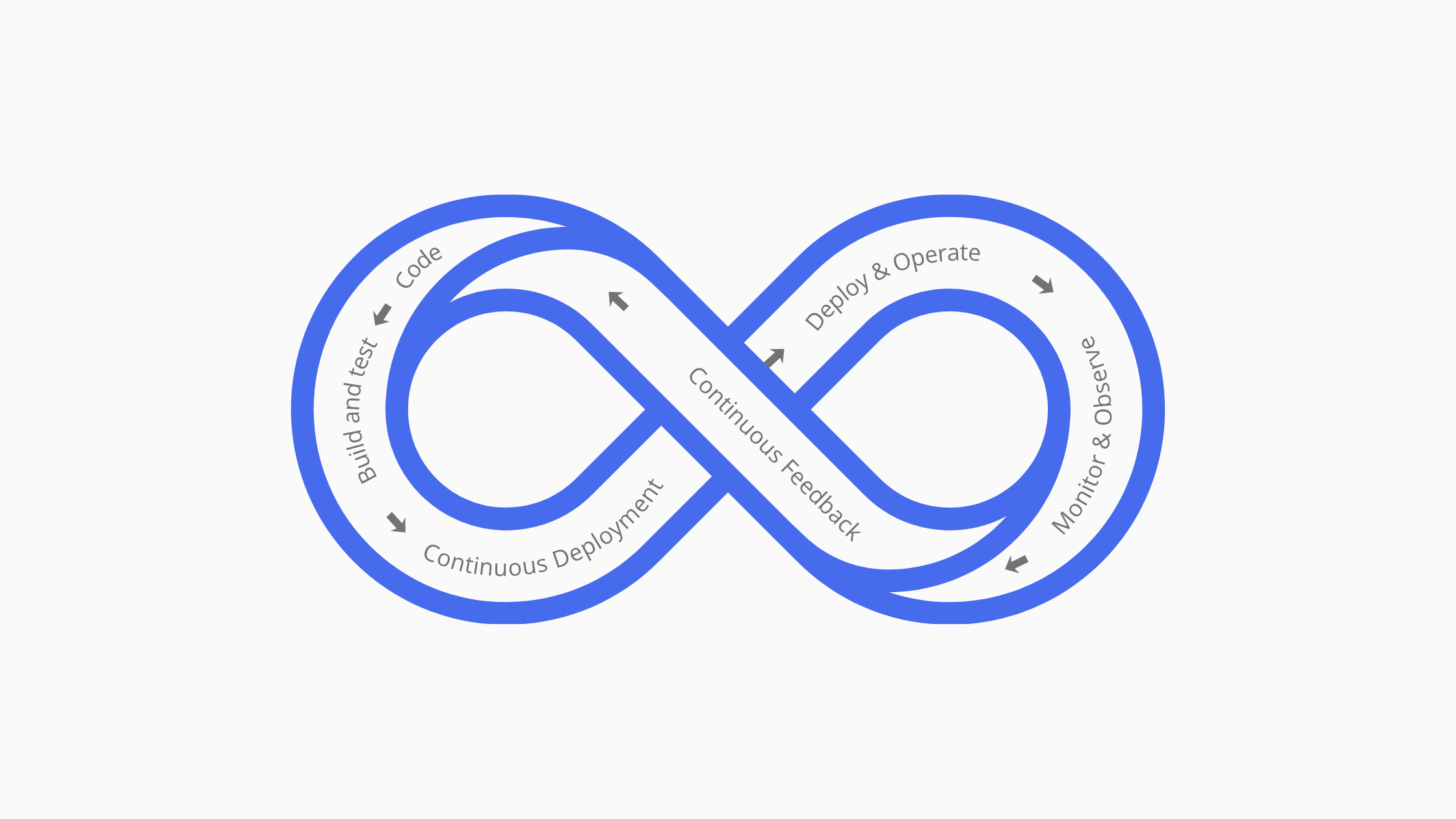
Platform engineering from the point of view of those in charge
For those who lead IT in a structured company, there are three dimensions that matter most:
- Productivity and time-to-market. By reducing the time developers devote to repetitive, non-differentiating tasks (configuring environments, requesting access, replicating pipelines), the platform frees up engineering capacity.
- Governance, security and compliance “by default”. At enterprise scale the risk is not only slowness, but inconsistency: configurations that differ from one another, security controls applied patchily, complicated audits. A well-designed internal platform builds security, policy and compliance directly into the standard paths, turning them from a bureaucratic brake into an automatic requirement.
- Retaining and making the most of talent. In a market where senior profiles are scarce and expensive, smooth, well-equipped working environments are a concrete factor in developer satisfaction.
There is, however, one aspect that deserves attention: platform engineering becomes an “empty fad” if it is misinterpreted. The two most common mistakes are:
- Building a platform without treating it as a product, imposing it from above without listening to the teams that are supposed to use it
- Starting it when the company is too small to justify its cost. For an organisation with few teams, the overhead can outweigh the benefit.
So then: fad or real turning point?
For large development organisations, it is a real turning point but not an automatic one, since it is not the technology that makes the difference but the approach: platform as a product, adoption driven by value, metrics in hand. Those who tackle it as a “top-down” infrastructure project risk producing yet another unused tool. Those who tackle it as a change of product and of culture get teams that are faster, more secure and more focused.
If you found the article useful, keep following our blog!