
Which features does a B2B e-commerce need?
A B2B e-commerce rests on five features: a user experience as polished as a consumer one but with professional logic, multiple accounts with custom price lists, deep integration with ERP and CRM, configurators and self-service, flexible payments. The rest of the work is in the analysis of internal processes, which comes before development.
B2B e-commerce has reached an extraordinary scale in recent years and keeps growing at a sustained pace. And we are not talking about a passing phenomenon! According to research by Shopify, the value of the global B2B e-commerce market reached 19.34 trillion dollars in 2024 and is expected to reach 47.54 trillion dollars by 2030, driven by the automation of supply chains and by business buyers’ increasingly established habit of operating online.
In this scenario, having a solid, fast and integrated B2B platform is no longer a “nice to have”: it is the key to staying competitive. But what does it mean to build an effective B2B e-commerce platform in 2025? Let us go beyond the clichés and analyse which features are making the difference in the market.
First, though, stop here and discover in detail the differences between B2B e-commerce and B2C e-commerce.
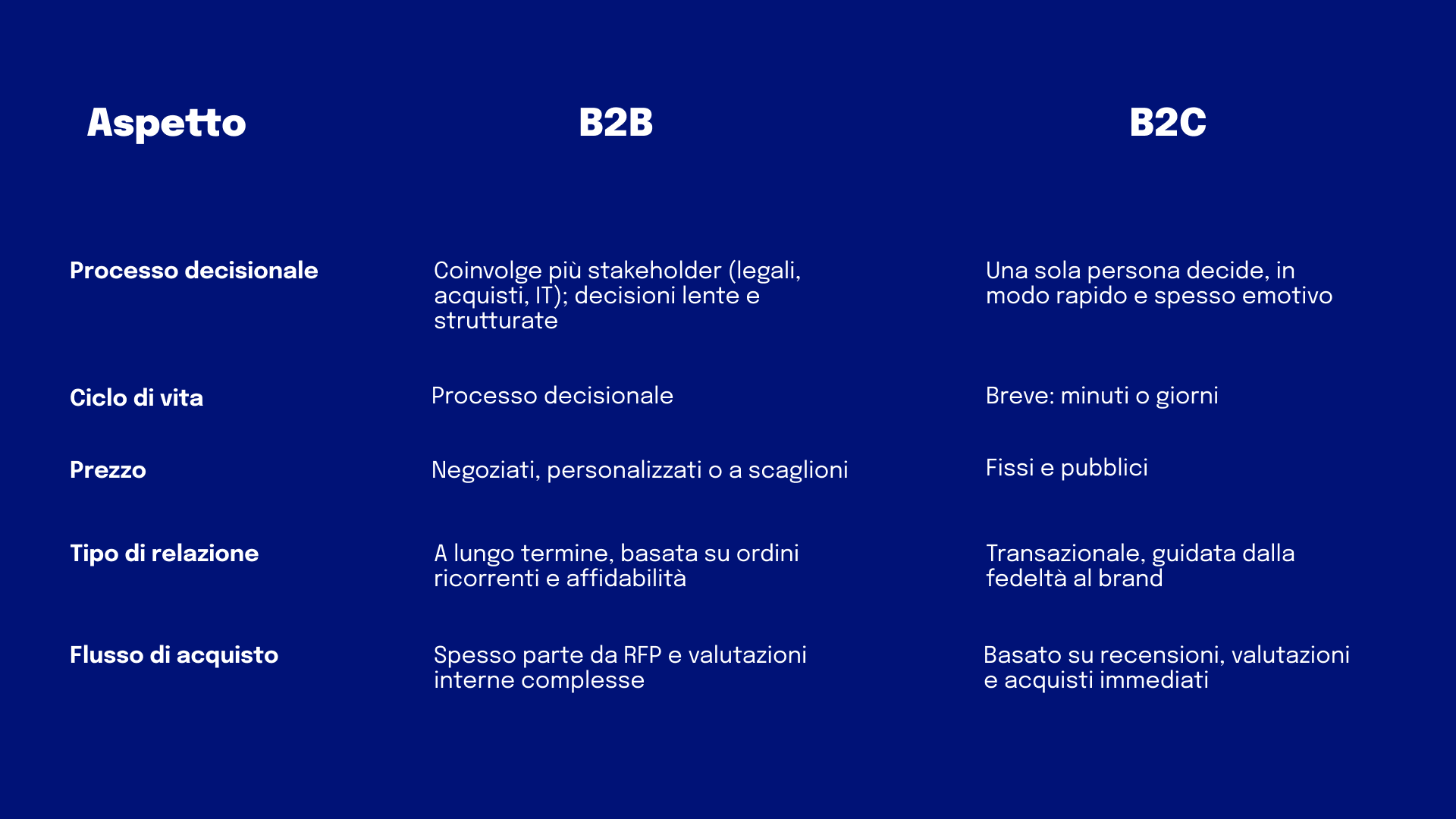
A market in search of opportunities
Anyone who works in the sector knows that online B2B is different from B2C, but no less important for that. The latest McKinsey (B2B Pulse Survey 2024) data divide decision makers (buyers) into 3 categories:
- Adapters: 44% of respondents are strongly relationship-oriented. Although willing to try new channels, they tend to stay loyal to models they are familiar with and are slow to try new experiences, channels and suppliers, even when the status quo is not satisfactory.
- Innovators: 20% are at the cutting edge when it comes to new technologies, including the use of artificial intelligence to search for suppliers. They are very likely to be present on all digital channels.
- Seekers: 36% demand a seamless omnichannel experience. If they do not get it, they are quick to look for a new supplier. They are also willing to spend a lot online.
This tells us two important things:
-
Companies are getting ready to approach platforms that let them order, configure and pay on their own.
-
Competition is played out more and more on the user experience and on integration with internal processes, not on price alone.
The must-have features of B2B e-commerce
Now let us get to the point. Which features must an e-commerce platform absolutely have to succeed? Let us look at them.
1. A “B2C-like” user experience, but with professional logic
Business buyers are consumers too: they expect the same ease of use they find on Amazon or Zalando. A B2B e-commerce platform must therefore offer advanced search, smart filters, suggestions based on purchasing behaviour, wishlists that can be shared between departments and a quick checkout to optimise negotiation times.
2. Multiple accounts and customised price lists
In B2B, a customer is never “just a customer”. There are often different teams, with different roles and authorisation levels. A modern platform must let you create hierarchical accounts, assign granular permissions and, above all, manage dedicated price lists based on volumes, framework agreements or market segments.
Let us take an example: Grainger, the US giant of industrial distribution, gives every corporate customer the option of creating sub-accounts for different departments, with automated approvals. The result? More than 80% of orders come from customers who are already loyal.
3. Deep integration with ERP and CRM
In 2025 it makes no sense to have an isolated B2B portal. The e-commerce platform must talk to the company ERP in real time, update stock levels, synchronise orders and automatically generate tax documents. It must also interface with the CRM to keep a detailed history of relationships and propose targeted upselling and cross-selling.
4. Advanced configurators and self-service
B2B sometimes also means selling complex solutions: machinery, plants, customised packaging, modular software. A good portal must therefore include interactive configurators that guide the customer through the choice, showing prices, delivery times and compatibility with other products in real time.
5. Flexible payments and digital trade finance
In B2B it is not enough to offer payment methods such as credit card or PayPal. Companies ask for deferred payments, electronic invoicing, recurring bank transfers and, more and more often, BNPL (Buy Now Pay Later) solutions dedicated to businesses. Some platforms integrate trade finance services, reducing credit risk and speeding up cash flows, thereby giving more breathing space to companies facing large payments.
Practical advice on how to build an efficient B2B e-commerce platform
Behind every platform there are complex challenges: managing internal processes, bringing different departments together, guaranteeing security and regulatory compliance (GDPR, electronic invoicing, handling of sensitive data). Here is some practical advice for getting off on the right foot:
-
Analyse internal processes before starting development, integrating logistics, accounting and sales. A B2B e-commerce platform must not duplicate work, but simplify it.
-
Choose (or design) a truly scalable platform, built around your needs. In complex B2B, off-the-shelf solutions are rarely enough. The real competitive advantage often comes from a custom platform, designed to integrate with the ERP, CRM and internal systems already in use.
-
Invest in the mobile experience. According to Statista, more than 40% of B2B buyers use a smartphone for preliminary research and quick reorders. Do not rule out opportunities!
-
Train your sales team, remembering that a B2B e-commerce platform does not replace salespeople, it empowers them. Your agents must know the platform perfectly and know how to use it to close contracts more quickly.
-
Monitor the data and improve constantly through analytics tools, to understand where customers drop off, which products generate the best margins and how to optimise the purchasing experience.

Think in terms of evolution: the value of a digital roadmap
A common mistake in companies is to approach B2B e-commerce as a “one-off” project rather than as a strategic journey. In reality, technology and customers’ needs evolve all the time: just think of the ever deeper integration with AI systems, virtual assistants and predictive analysis modules that are entering B2B today.
It is therefore important to define a multi-year digital roadmap that sets priorities, timings and budgets for future developments. It means designing a platform that meets current needs today, but is already set up to support tomorrow:
- New sales channels (vertical marketplaces, integrations with mobile apps dedicated to partners)
- Dynamic pricing logic based on machine learning algorithms
- User experiences driven by ever smarter recommendation systems.
A B2B e-commerce platform conceived in this way is not just an operational tool, but a real growth engine able to adapt to your sector, your customers and your strategy.
Having a showcase site is not enough. Companies that invest in integrated, modern B2B e-commerce are gaining market share because they respond to buyers’ new expectations: autonomy, speed, transparency.
If you run B2B sales, the portal is your ERP talking to customers: price lists by contract, recurring orders, stock levels in real time. It is the kind of project where ready-made CMSs stop where your process begins, and the rest is built as a custom web app, integrated with the systems you already have.