
What are the phases of the software life cycle?
The software life cycle is made of seven phases: requirements gathering, analysis, design, development, testing and integration, deployment, maintenance. Gathering outlines the goals and needs of whoever commissions the work; analysis turns them into technical specifications; design decides architecture, technologies and interfaces before any code is written.
When we think about software development, we often picture programmers hunched over their keyboards, busy writing code. Yet behind every successful piece of software there is much more than writing code; there is a well-defined process that guides every step, from the initial idea through to release and maintenance. This process, known as the software life cycle, is the beating heart of any technology project.
Let us discover together the crucial phases of this cycle, revealing all the steps that make it possible to turn a simple idea into a successful digital solution.
The phases of the software life cycle
The path of the software life cycle is marked by clearly distinct phases, fundamental to guaranteeing a solution that performs well, scales and is reliable.
Requirements gathering
This phase of the software life cycle aims to outline the customer’s needs and goals through interviews and the analysis of documents. All of this helps to avoid misunderstandings and changes, which can be costly in the later phases of development.
Analysis
Once the requirements have been gathered, we move on to a detailed analysis to turn them into technical specifications for development. This phase can be divided into:
- analysis of functional requirements
- analysis of non-functional requirements
- system modelling.
Design
Once the requirements have been established and properly analysed, we move on to the actual design of the overall architecture of the software and of the technologies and languages to be used. The various components are established, along with the documentation on how the software is built, and work proceeds with the UX/UI studies and designs.

Development or implementation
During this phase, the software is actually developed on the basis of the design that has been defined. The requirements are thus turned into real, working software, through the use of coding best practices and version control tools, to guarantee the quality of the code.

Testing and Integration
Once development is complete, the software must be thoroughly tested to make sure it works as expected, meets the requirements and is free of bugs. This phase covers unit tests, integration tests, system tests and acceptance tests.
Deployment
Once the tests have been passed, the software is installed in the production environment in which it will be used by users. Deployment can take place in different ways, depending on the nature of the software: it can be installed on local devices, distributed through the cloud, or released as an update to existing software.
Maintenance
A significant share of resources is devoted to software maintenance. From fixing bugs, to improving performance, through to adding new features in response to user feedback, this phase can be divided into corrective, adaptive and perfective, depending on the goal to be achieved.

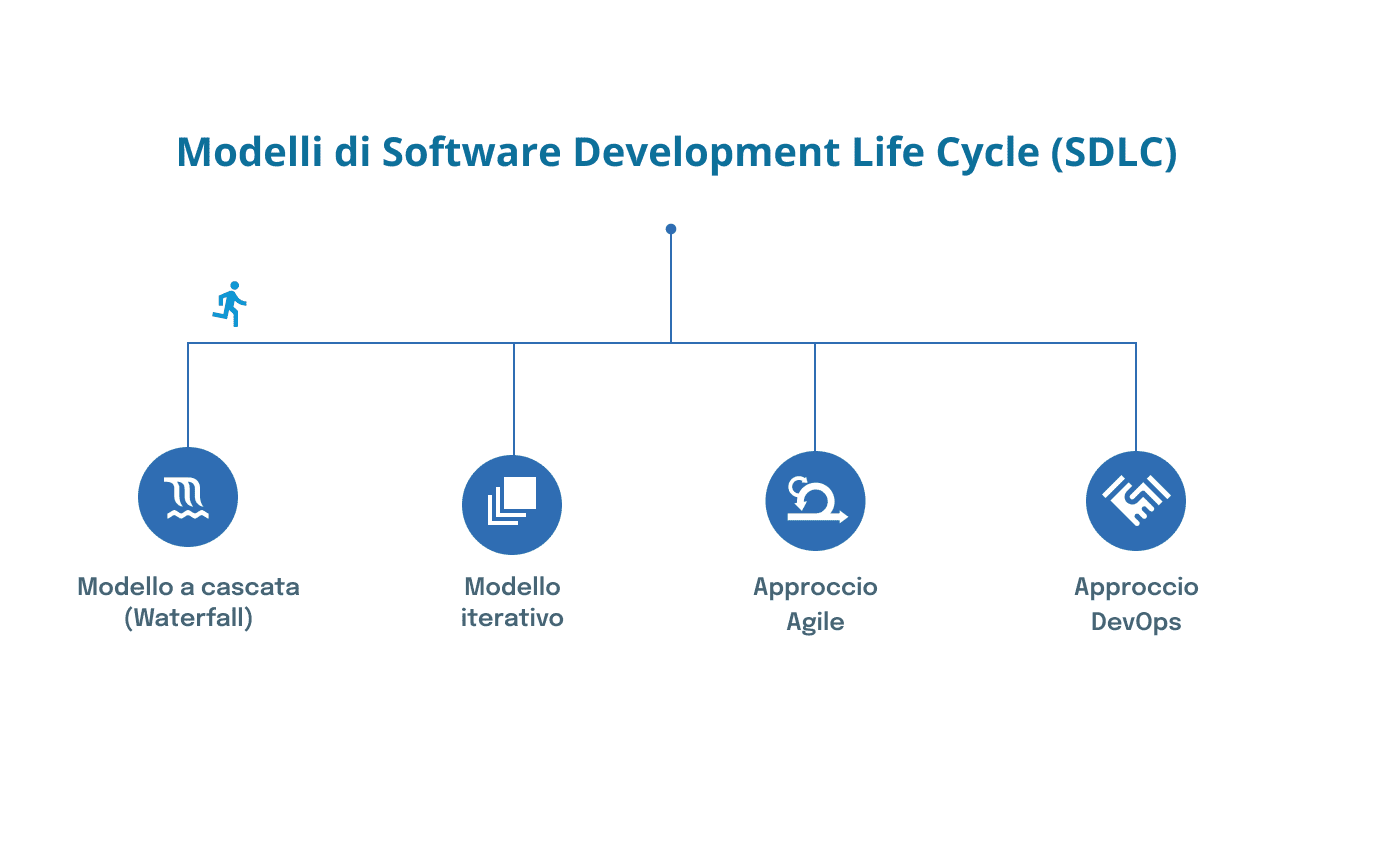
Software Development Life Cycle (SDLC) models
In the software development life cycle there are different models, which vary according to the type of software to be built. Let us summarise the main ones:
- Waterfall model, the most traditional. It is a sequential model in which each phase of the process is finished before moving on to the next. It is simple and clear to manage, but can make it hard to handle changes once work has begun.
- Iterative model, based on splitting development into smaller cycles. Each iterative cycle develops a partial version of the software, which is then improved and completed in later iterations. This model reduces risks and allows continuous feedback, but can lead to the project running longer.
- Agile approach, flexible and adaptable, which promotes collaboration between team and customer, adaptation and rapid delivery. The phases repeat in short cycles called sprints. This approach is highly flexible and involves customers heavily. It requires disciplined, coordinated teams.
- DevOps approach, which integrates development (Dev) and operations (Ops) in a single continuous flow, with a focus on collaboration and automation to speed up the software release cycle. This approach guarantees speed of release but can require a significant reorganisation of the company, as it is complex to implement.
Why is it important to manage the software life cycle?
Managing the software life cycle properly is crucial to the success of a project. A rigorous approach makes sure every phase is completed effectively, reducing the risks of unexpected costs, delays or project failure.
At dotenv, by listening to the customer’s needs, we adapt the various models and approaches of the software life cycle to the types of project that come our way, to create efficient, long-lasting software solutions.